
Spark tuning needs a testable recommendation
AWS’s new Spark optimization agent connects tuning advice to job telemetry. Teams still need to prove that the next run improves the outcome they care about.
What AWS announced
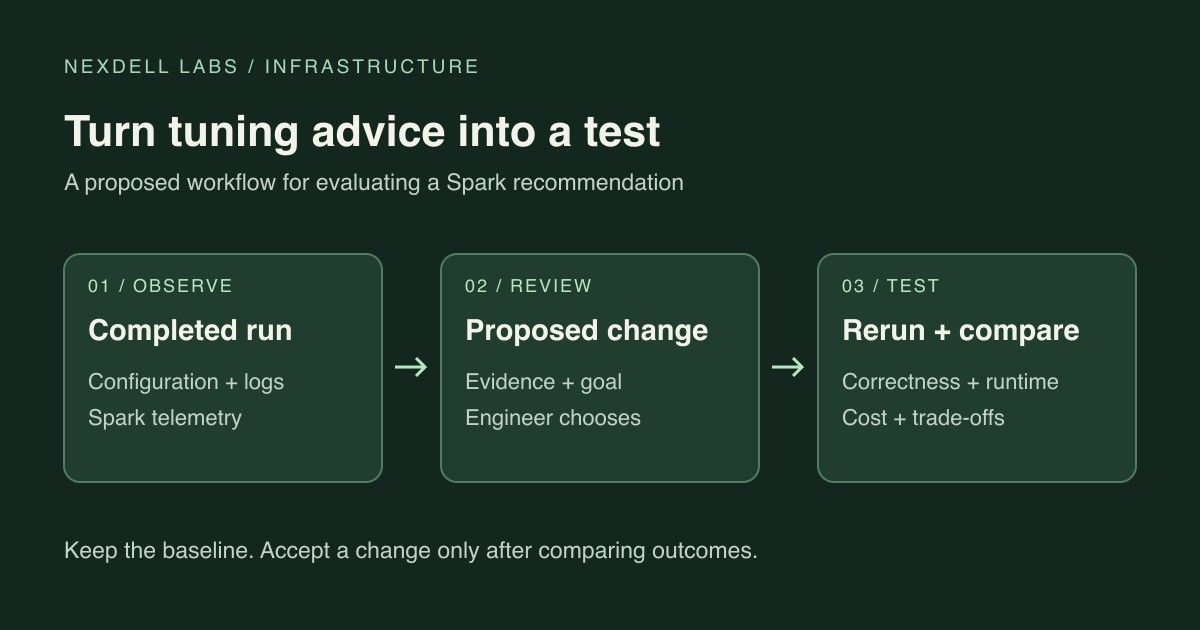
On November 18, AWS announced the Apache Spark Optimization Agent for AWS Glue ETL. Engineers choose a cost or performance goal for a completed job run and receive configuration recommendations with supporting telemetry. AWS’s accompanying launch post says the agent also supports Amazon EMR Serverless and can compare a run against a known-good baseline. It is read-only: engineers decide which changes to apply.
Why the evidence matters
AWS describes a recommendation engine that combines rules and deterministic models, with an AI model bringing findings together with a knowledge base. For product teams building operational assistants, the useful design pattern is advice that exposes its basis: the observed bottleneck, the proposed change, and the goal it serves. A persuasive explanation alone cannot establish that a change will help the next workload.
Make the next run the test
Our practical consequence: treat a tuning suggestion as a hypothesis. Choose a recurring job with a stable input snapshot, record its current configuration, and test one recommendation. Compare output correctness, runtime, and cost across repeated runs so ordinary variation does not masquerade as improvement. Set an acceptable trade-off before testing and retain the previous settings. Can the team explain why it accepted the change using the results of the rerun?